Electronic waste is not a material. It is a construction.
A printed circuit board is a composite laminate in which copper tracks are bonded to a fibreglass-reinforced resin substrate, components are soldered to the surface, and connectors are press-fitted and mechanically locked. A hard drive is a sealed aluminium enclosure containing platters, magnets, and a read arm assembly. A refrigerator is a steel shell containing a compressor, copper tubing, wiring, and foam insulation.
None of these items can be separated while they remain intact. The materials must be freed from the assemblies that contain them. That process is called liberation. And liberation is the function of the HUATAO Double Shaft Shredder at the primary reduction stage of an e-waste recycling line.
Why Liberation Comes Before Separation
An e-waste recycling line follows a predictable sequence: feedstock reception, primary size reduction, ferrous separation, non-ferrous separation, granulation, and output handling. The HUATAO Double Shaft Shredder operates at the primary size reduction stage, positioned immediately after feedstock reception and before any separation equipment.
This position is not arbitrary. Magnetic separators, eddy current separators, and screening systems cannot function efficiently when fed whole appliances, complete cable bundles, or intact circuit boards. They operate on liberated particles. Feed them intact assemblies, and recovery rates fall while operating costs rise.
The purpose of primary shredding is therefore not uniform size reduction. It is structural failure of the assemblies. Fasteners must break. Bonded layers must delaminate. Components must separate from substrates. Only when these connections fail can downstream separation distinguish individual materials.
Full specifications of the machine are on the Double Shaft Shredder Machine page, with individual capacity tiers described under the 600 Type Double Shaft Shredder, 800 Type Double Shaft Shredder, 1000 Type Double Shaft Shredder, and 1200 Type Double Shaft Shredder pages.
The Shear Principle: Why Impact Fails on E-Waste
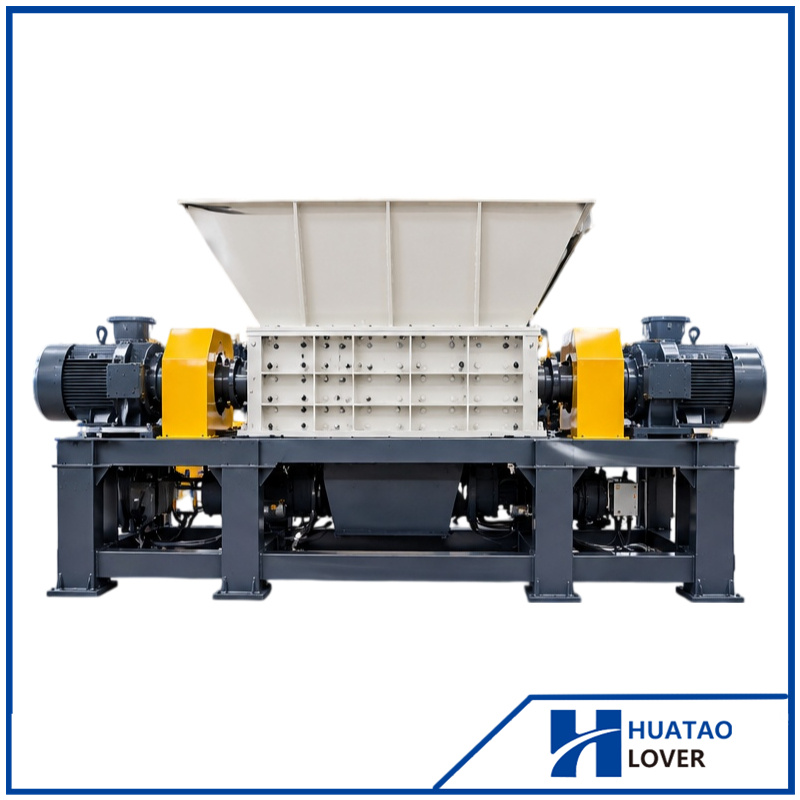
The HUATAO Double Shaft Shredder uses two counter-rotating shafts fitted with hardened cutting blades. Shaft speeds typically run in the range of 10 to 40 RPM, with torque multiplied through planetary gear reducers. There is no high-speed impact.
This design choice is deliberate, and it matters for e-waste because of the diversity of materials present. A single feed stream may contain steel chassis components, aluminium heat sinks, copper windings, glass display panels, and a dozen polymer types. These materials have dramatically different mechanical properties.
Impact-based reduction applies a single force profile to all of them. The result is unpredictable: brittle materials shatter into fines, ductile materials deform rather than break, and mixed assemblies may separate partially or not at all.
Shear-based reduction applies sustained force until the material yields, regardless of whether it is brittle, ductile, or composite. The counter-rotating geometry creates a self-feeding effect, drawing material down between the shafts rather than allowing it to bounce on top. This is why the HUATAO Double Shaft Shredder can process whole devices, tangled cable, and irregular assemblies that would stall a single-rotor machine.
Contamination Tolerance and Anti-Jamming Protection
E-waste arrives with contaminants that would damage or stall other equipment. Appliances contain refrigerant lines, oil residues, and rubber seals. Cable assemblies contain insulation that wraps around rotating components. Mixed loads may contain items that were never designed to be recycled.
The HUATAO Double Shaft Shredder tolerates a degree of contamination that would cause problems for finer reduction equipment. Its low rotational speed and high torque allow it to process materials that would jam a high-speed machine, and its robust construction withstands the shock loads imposed by hard inclusions.
The PLC control system provides intelligent anti-jam protection. When encountering ultra-hard electronic accessories or irregular mixed scrap, the system automatically triggers reverse rotation and overload protection, protecting blades and main shafts from damage. This design reduces manual cleaning frequency and downtime loss, improving overall plant productivity and operational stability.
What the Shredder Actually Produces?
The output of the primary shredding stage is not a uniform product. It is a liberated mixture: metal fragments, plastic pieces, circuit board sections, cable segments, and mixed particles, typically in the range of 50 to 150 mm.
This mixture is precisely what downstream separation equipment requires. Not uniform size — uniform liberation.
And this is where the HUATAO Double Shaft Shredder differs from machines that prioritise throughput over liberation quality. The goal is not to reduce the material as quickly as possible. The goal is to break the structural connections completely, so that every subsequent stage can operate at its design efficiency.
A shredder that produces inconsistent liberation forces every downstream machine to compensate. The magnetic separator recovers ferrous material with copper still attached. The eddy current separator recovers non-ferrous material with plastic still bonded to it. Both fractions lose value.
The Two-Stage Configuration for E-Waste
E-waste liberation frequently requires two reduction stages.
The HUATAO Double Shaft Shredder performs primary reduction, reducing whole devices and assemblies to a coarse liberated mixture. A Single Shaft Shredder then performs secondary reduction, producing a finer and more uniform particle size suitable for separation.
The division of labour is deliberate. The Double Shaft Shredder handles the difficult work of gripping and tearing. The Single Shaft Shredder produces the controlled particle size that separation equipment requires. Attempting both functions with one machine produces compromises in both.
Available single-shaft models include the Single Shaft Shredder HT600 Series, the Single Shaft Shredder 800 Type, the Single Shaft Shredder HT 1000 Type, and the Single Shaft Shredder 1200 Type.
The screen aperture on the single shaft shredder is the variable that connects reduction to separation. Too coarse, and the eddy current separator cannot eject fine particles effectively. Too fine, and valuable metal fines are lost in the dust collection system.
Integration with Downstream Separation
The HUATAO Double Shaft Shredder does not operate in isolation. It is the first stage in a configured line.
After shredding, magnetic separation removes ferrous metals. This stage protects downstream equipment and produces a saleable steel fraction. It also makes non-ferrous recovery possible — an Eddy Current Separator cannot process ferrous metals, because the attractive forces on iron and steel are stronger than the repulsive forces used in eddy current separation.
Eddy current separation then recovers aluminium, copper, brass, and zinc. The effectiveness of this stage depends on the particle size and liberation quality achieved upstream.
And dust control runs throughout the line, because shredding and separation generate fine resin and metal dust that must be captured without removing valuable metal fines. The E Waste Recycling Line High Purity Zero Discharge Systematic Solution incorporates pulse dust removal and negative pressure closed circulation systems, with extraction points positioned to control dust without removing recoverable material.
For circuit board specific processing, the Circuit Board Shredder page describes primary reduction configurations, and the Circuit Board Crushing And Sorting Production Line page sets out the complete PCB recovery sequence.
Maintenance: The Variable That Determines Everything
The HUATAO Double Shaft Shredder operates in a high-wear environment. Glass, ceramics, and fibreglass-reinforced plastics are abrasive, and shock loads from unshreddable inclusions can damage blades and shafts.
Blade condition is the single most important variable. Dull blades do not simply reduce throughput. They produce a wider particle size distribution with more fines and more partially liberated fragments. That degradation propagates through the entire separation sequence.
A structured maintenance programme is set out in the Twin Shaft Shredder Maintenance Guide Extend Service Life Cut Operational Cost. Blade rotation at planned intervals extends service life. Timely sharpening maintains cutting efficiency and liberation quality.
An Industrial Knife Grinding Machine restores blades to specification, and replacement blades are available as Huatao Wear Resistant Customization Shredder Blades.
Blade care guidance is available in Optimizing Shredder Blade Usage A Comprehensive Guide To Efficiency And Longevity, The Most Important Part Of Shredder Shredder Blades, and Did You Know That Crusher Blades Become Dull After Prolonged Use.
The Point
Electronic waste contains some of the highest concentrations of recoverable metals in any recycling stream.
But the value is not recovered by the separator alone. It is recovered by a sequence, and the sequence begins with liberation.
The HUATAO Double Shaft Shredder performs that first step. Its low-speed, high-torque shearing action breaks the bonds between materials, producing a liberated mixture that downstream equipment can process. Without it, the resource remains locked. With it, the e-waste begins its journey from disposal problem to recovered resource.
For complete e-waste configurations, see the E Waste Recycling Line High Purity Zero Discharge Systematic Solution. The broader Waste Recycling Production Line covers multi-stream applications, and HUATAO Configuring the Metal Recycling Line for Complex Feedstocks: From ELVs to E-Waste addresses e-waste within the wider metal recovery context.
Contact us:
Marketing@huataogroup.com
Tel:+86 13383116640 (WeChat/WhatsApp)
http://wa.me/13383116640
Website: www.huataoshredder.com
#HUATAO #DoubleShaftShredder #EWasteRecycling #ElectronicScrap #Liberation #WEEERecycling #CircularEconomy #WasteManagement #RecyclingEquipment #MetalRecovery



 WhatsApp