1. Quick Answer
The best industrial shredder for e-waste recycling depends on the type of electronic waste, feed dimensions, material composition, required throughput and target output size. Double shaft shredders are commonly considered for primary size reduction of bulky electronic scrap, while single shaft shredders can be used for secondary processing and more controlled output sizing.
2. Key Takeaways
-
Identify the main electronic waste materials before selecting a machine.
-
Match the shredder configuration to material dimensions and cutting resistance.
-
Evaluate blade design, motor power and processing capacity together.
-
Plan downstream metal separation before finalizing the shredder.
-
Consider maintenance, safety and total operating costs.
3. What Is an Industrial E-Waste Shredder?
An industrial e-waste shredder is a mechanical size-reduction machine designed to process discarded electronic products into smaller fragments for subsequent sorting, separation and material recovery.
Typical feed materials include:
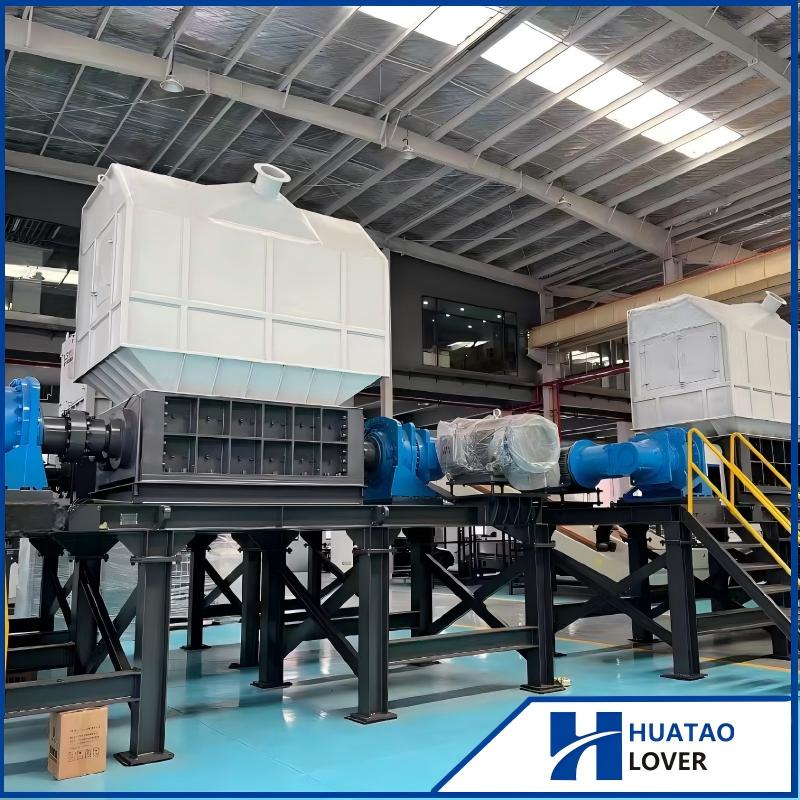
For primary shredding applications, a DOUBLE SHAFT SHREDDER MACHINE can be considered because its counter-rotating cutters provide a shearing action on bulky materials.
4. Working Principle
A double shaft shredder typically operates through two parallel rotating shafts equipped with intermeshing cutting blades.
The process involves:
-
Electronic waste enters the feeding hopper.
-
Rotating cutters grip the incoming materials.
-
The materials are torn and sheared into smaller fragments.
-
Processed materials are discharged for further treatment.
For applications requiring more controlled particle sizes, a SINGLE SHAFT SHREDDER may be considered for secondary size reduction.
The final machine configuration depends on the feedstock and downstream process.
5. Benefits of Industrial E-Waste Shredding
Proper shredding provides several benefits:
Improved Material Handling: Smaller fragments are easier to convey and process.
Better Material Liberation: Size reduction can expose different material fractions for subsequent separation.
Improved Sorting Preparation: Shredded materials can be prepared for magnetic and eddy current separation.
Process Integration: Shredding can become the primary size-reduction stage in a complete recycling system.
6. Application and Material Comparison
| Material |
Main processing consideration |
Equipment direction |
| Computers |
Mixed plastic and metal housings |
Primary shredding |
| Circuit boards |
Fiberglass, copper and resin |
Dedicated PCB processing |
| Electrical cables |
Conductors and insulation |
Shredding and granulation |
| Printers |
Mixed mechanical components |
Pre-processing |
| Household appliances |
Bulky structures and metals |
Heavy-duty primary shredding |
For circuit board applications, explore the CIRCUIT BOARD CRUSHING AND SORTING PRODUCTION LINE.
7. Single Shaft vs. Double Shaft Shredder
| Factor |
Single shaft |
Double shaft |
| Main application |
Secondary size reduction |
Primary size reduction |
| Cutting structure |
Rotor and counter knives |
Two counter-rotating shafts |
| Feeding |
Often hydraulic pusher |
Application-dependent |
| Output control |
Screen-based in many designs |
Depends on cutter and machine design |
| Typical use |
Pre-processed materials |
Bulky mixed materials |
Neither configuration is universally better. The correct selection depends on the material and required processing result.
8. How to Select the Right Shredder
Before requesting a quotation, prepare the following information.
Feedstock Information
-
Material type and composition.
-
Maximum feed dimensions.
-
Presence of steel, aluminum or reinforced materials.
-
Whether materials are dismantled or mixed.
Production Requirements
-
Required tons per hour.
-
Daily operating schedule.
-
Desired output dimensions.
-
Downstream separation equipment.
Machine Requirements
-
Shaft configuration.
-
Motor power and torque.
-
Cutting chamber dimensions.
-
Blade material and design.
-
Electrical control and safety protection.
A suitable machine should be selected according to actual feedstock conditions rather than estimated capacity alone.
9. Complete E-Waste Recycling Process
A complete e-waste recycling system may contain:
Pre-treatment → Primary Shredding → Secondary Crushing → Screening → Magnetic Separation → Eddy Current Separation → Material Collection
Important related equipment includes:
The separation system must be matched to the particle-size distribution and material characteristics produced by the shredder.
10. Procurement Guide
When purchasing an industrial shredder, buyers should prepare:
| Item |
Information required |
| Material samples |
Actual electronic waste |
| Drawings |
Maximum feed dimensions and layout |
| Capacity |
Required hourly throughput |
| Output |
Target particle size |
| Blade requirements |
Material and cutting structure |
| Electrical system |
Local voltage and frequency |
| Spare parts |
Recommended replacement inventory |
| Packaging |
Export packaging requirements |
| Inspection |
Test-running and inspection arrangements |
Ask suppliers:
-
Can the machine process your actual material?
-
Can they recommend a suitable configuration?
-
Can they provide a machine layout?
-
Can they supply replacement blades?
-
Can they support installation and maintenance?
-
Do they have international export experience?
11. Common Problems and Solutions
| Problem |
Possible cause |
Recommended action |
| Low throughput |
Unsuitable feed size or feeding |
Review feeding and machine configuration |
| Blade wear |
Abrasive materials or incorrect blade selection |
Inspect and evaluate blade material |
| Shaft jamming |
Oversized or unsuitable feed |
Improve pre-sorting and feeding |
| Excessive vibration |
Loose components or imbalance |
Stop and inspect the machine |
| Poor output consistency |
Inappropriate cutting configuration |
Review rotor and screen design |
For additional guidance, read COMMON DOUBLE SHAFT SHREDDER ISSUES.
12. Maintenance Recommendations
-
Daily: Check abnormal noise, vibration and material accumulation.
-
Weekly: Inspect cutters, fasteners and feeding components.
-
Monthly: Review blade wear and mechanical condition.
-
Periodically: Check gearbox, bearings and electrical protection according to the manufacturer's maintenance schedule.
The DOUBLE SHAFT SHREDDER MAINTENANCE GUIDE provides additional maintenance information.
For blade maintenance, see SHREDDER BLADE PERFORMANCE AND SERVICE LIFE.
13. Safety Considerations
E-waste may contain lithium-ion batteries, capacitors and other hazardous components.
These materials must be identified and appropriately removed or processed through dedicated systems before conventional shredding.
The recycling facility should also consider guarding, emergency stops, overload protection and dust collection.
14. Frequently Asked Questions
Q1: What type of shredder is suitable for electronic waste?
A double shaft shredder is commonly considered for bulky electronic scrap and primary size reduction. A single shaft shredder can be used for suitable secondary processing applications. The final choice depends on material composition, dimensions and output requirements.
Q2: Can a double shaft shredder process circuit boards?
It can be considered for certain primary size-reduction applications, depending on PCB dimensions and construction. However, specialized PCB recycling may require additional crushing, screening and separation stages.
Q3: How do I determine the required shredder capacity?
Calculate the hourly feed requirement based on daily material volume and operating hours. Then consider feeding interruptions, material density and the capacity of downstream equipment.
Q4: Does higher motor power always mean higher capacity?
No. Production also depends on cutting torque, rotor speed, blade structure, feeding efficiency and material characteristics. Motor power should be evaluated together with the complete machine configuration.
Q5: How often should shredder blades be replaced?
There is no universal replacement interval. Blade life depends on feedstock, contaminants, blade material and operating conditions. Regular wear inspection is recommended.
Q6: Can the shredder be integrated into a complete e-waste recycling line?
Yes. It can be integrated with conveyors, secondary crushers, screens and metal separation equipment. The process layout should be designed around the target recovered materials.
Q7: What information should I send when requesting a quotation?
Provide material photographs, feed dimensions, estimated capacity, target output size, local electrical requirements and available installation space. Material samples are helpful for evaluating application suitability.
Q8: What safety issues should be considered?
Battery-containing materials and other hazardous components require appropriate identification and handling before conventional shredding. Dust control, guarding, emergency stops and overload protection should also be included in the equipment evaluation.
15. Conclusion
Selecting an industrial shredder for e-waste recycling requires a complete understanding of material characteristics, production requirements and downstream processing.
A suitable machine should provide reliable size reduction while supporting efficient material separation and manageable maintenance costs.
HUATAO offers industrial shredders, crushing equipment, separation machinery and recycling line solutions for different recycling applications.
Email: marketing@huataogroup.com
Tel/WeChat/WhatsApp: 008613383116640 Website: www.huataoshredder.com
WhatsApp: http://wa.me/13383116640



 WhatsApp