crusher blades gradually lose their cutting performance during continuous industrial operation. As the cutting edge wears, operators may notice reduced processing efficiency, changes in output consistency, and increased maintenance requirements.
However, a dull blade does not always need to be replaced.
The key is to distinguish normal cutting-edge wear from structural damage and excessive dimensional loss.
When Should Blades Be Sharpened?
Sharpening may be suitable when the blade has become dull but remains structurally sound.
Common signs include:
-
Rounded or blunt cutting edges.
-
Reduced cutting efficiency.
-
Longer processing time under similar conditions.
-
Changes in output consistency.
-
Sufficient remaining blade thickness for regrinding.
Suitable industrial knife grinding machines can help restore cutting edges when the blades meet the required regrinding conditions.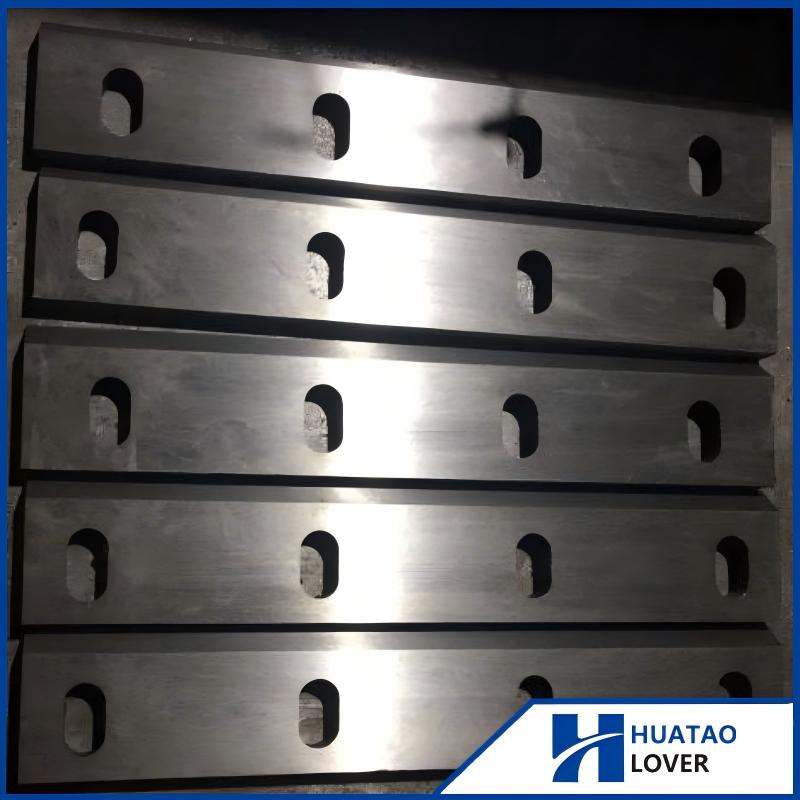
When Should Blades Be Replaced?
Replacement should be considered when:
-
Structural cracks are visible.
-
Deep chips cannot be safely removed.
-
The blade has reached its minimum permitted dimensions.
-
Mounting areas are damaged or deformed.
-
The required cutting geometry cannot be restored.
For replacement requirements, review our shredder spare parts.
Why Is Blade Inspection Important?
Before deciding, maintenance teams should inspect:
-
Cutting-edge condition.
-
Remaining blade thickness.
-
Blade geometry.
-
Mounting holes and fastening areas.
-
Actual machine performance.
The inspection should also consider the machine structure.
For single shaft shredders, rotating and fixed blade clearance is important.
For double shaft shredders, rotor arrangement and blade compatibility should be checked.
For plastic granulator machines, blade condition influences cutting performance and output quality.
How Can Blade Service Life Be Improved?
Regular inspections, proper installation, suitable grinding procedures, and accurate maintenance records can help extend blade service life.
A suitable chipper blade sharpener can support reconditioning of suitable blades.
For more technical information, read our article on precision blade maintenance and knife grinding.
Blade performance also interacts with other processing equipment, including crusher machines and vibrating screen panels.
Learn more about our waste recycling production lines, crusher equipment, and recycling machinery.
Conclusion
Sharpening and replacement are both important parts of shredder blade maintenance.
If a blade is dull but structurally sound and within its permitted dimensions, regrinding may be suitable.
If it has cracks, severe damage, deformation, or insufficient remaining material, replacement should be considered.
Regular inspection helps operators make better maintenance decisions, reduce unnecessary costs, and maintain stable production.
Contact Us
Email: marketing@huataogroup.com
Tel/WeChat/WhatsApp: 008613383116640
WhatsApp: http://wa.me/13383116640
Website: https://www.huataoshredder.com
#ShredderBlades #IndustrialMaintenance #BladeSharpening #BladeReplacement #RecyclingEquipment #ShredderParts



 WhatsApp