1. What Is Aluminum Recovery with an ECS?
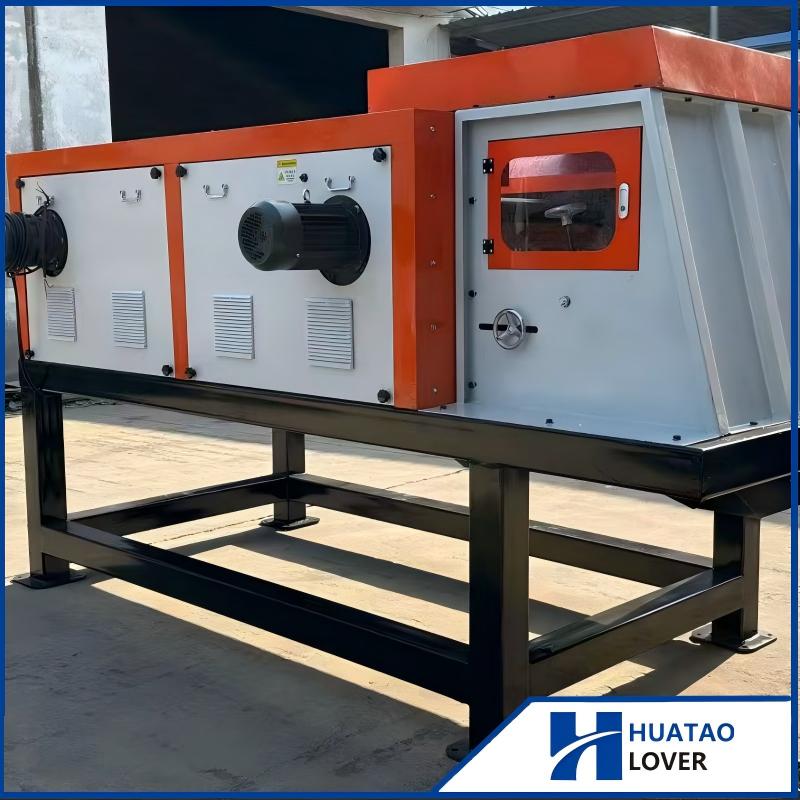
Aluminum recovery with an Eddy Current Separator is a dry physical separation process. A rotating magnetic rotor creates a changing magnetic field. Conductive particles such as aluminum develop induced currents and are deflected away from non-conductive materials.
The Eddy Current Separator is therefore commonly considered for mixed waste, scrap metal, and non-ferrous recovery applications.
2. Working Principle: From Mixed Waste to Aluminum Fraction
The process generally includes five stages:
-
Size Reduction: Bulky waste is reduced using suitable shredding or crushing equipment.
-
Screening: Material is classified by particle size.
-
Ferrous Removal: Magnetic equipment removes iron and steel.
-
Eddy Current Separation: Conductive non-ferrous particles are repelled by the rotor's changing magnetic field.
-
Collection: A splitter directs the aluminum-rich fraction into a separate discharge area.
For bulky scrap, a Double Shaft Shredder Machine may be used upstream. A Vibrating Screen Machine can support size classification.
3. Benefits and Applications
ECS can help recycling plants recover valuable non-ferrous metals without relying on manual picking alone. Typical applications include:
-
Aluminum cans and packaging
-
Automotive shredder residue
-
Electronic waste
-
Mixed municipal waste
-
Plastic and metal mixtures
-
Industrial scrap
Related process solutions include the Scrap Metal Recycling Production Line, Waste Recycling Production Line, and Circuit Board Crushing and Sorting Production Line.
4. Material Comparison
| Material |
ECS Suitability |
Notes |
| Aluminum |
Suitable |
Common target material |
| Copper |
Suitable |
May report to a different trajectory |
| Brass |
Suitable |
Conductive non-ferrous metal |
| Iron / Steel |
Not the target |
Remove magnetically first |
| Plastic |
Non-metallic |
Follows its natural discharge path |
| Glass |
Non-metallic |
Requires suitable size and feed presentation |
| Stainless steel |
Not reliably separated by standard ECS |
May need dedicated sensor sorting |
5. Selection Guide
Before selecting equipment, evaluate:
-
Feed composition and aluminum content
-
Particle-size distribution
-
Particle shape and thickness
-
Feed rate and layer depth
-
Moisture and sticky contamination
-
Required product purity
-
Available downstream sorting equipment
For plastic-rich streams, see Automatic Plastic and Non-Ferrous Metal Sorting and Efficient Plastic and Non-Ferrous Metal Sorting.
6. Procurement Guide
A quotation request should include material photos, composition, particle-size range, expected throughput, ferrous content, moisture level, target aluminum fraction, and installation conditions.
Ask the supplier whether it can review a representative sample, recommend a suitable rotor configuration, explain maintenance requirements, and provide a clear scope of supply. Confirm electrical requirements, installation dimensions, wear parts, packaging, lead time, and export documentation.
7. Failure Analysis
| Problem |
Possible Cause |
Recommended Action |
| Low aluminum recovery |
Poor liberation |
Review upstream size reduction |
| Aluminum enters residue |
Incorrect splitter setting |
Conduct controlled adjustment |
| Unstable separation |
Uneven feeding |
Improve feeder distribution |
| Poor fine-particle recovery |
Particle size too small |
Review fine-particle sorting options |
| Material blockage |
Wet or sticky feed |
Improve conditioning and cleaning |
8. Maintenance Guide
-
Daily: Inspect conveyor belt, feed distribution, guards, and discharge areas.
-
Weekly: Check belt tracking, splitter condition, and material buildup.
-
Monthly: Inspect rotor enclosure, bearings, drive components, and electrical controls according to the manufacturer's instructions.
-
Ongoing: Record feed composition, product quality, and downtime.
9. Case Study – Illustrative Application
Customer type: Mixed-waste recycling facility
Material: Shredded packaging and mixed industrial waste
Problem: Aluminum fragments remain mixed with plastic and other residues.
Solution: Review the feed preparation, remove ferrous metals first, and evaluate ECS separation with representative samples.
Result: The process is designed to create a separate non-ferrous-rich stream for further quality assessment. No numerical recovery rate is claimed because no verified test data is available.
10. FAQ
Q1. Can ECS recover aluminum from mixed waste?
Yes. It can recover suitable conductive aluminum particles from prepared mixed streams. Performance depends on particle size, shape, liberation, and feed presentation. A sample test is recommended before final equipment selection.
Q2. Why remove iron before ECS?
Magnetic separation removes ferrous metals more effectively and helps prevent iron pieces from entering the ECS feed. This creates a more suitable stream for non-ferrous separation.
Q3. Can ECS separate aluminum from copper?
It can produce different trajectories for conductive metals, but a standard ECS should not be assumed to provide precise alloy-by-alloy sorting. Additional sensor or density-based processes may be needed.
Q4. Does aluminum particle size matter?
Yes. Very small particles may be harder to separate, while oversized or irregular pieces can affect feed distribution. Screening and testing help determine suitable size fractions.
Q5. Can wet waste be processed?
Excessive moisture and sticky materials can cause agglomeration and unstable feeding. Drying, dewatering, or conditioning may be needed depending on the material.
Q6. What affects the price of an ECS?
Price depends on working width, rotor design, feed requirements, controls, and integration scope. A reliable quotation needs material and capacity details.
Q7. How often should an ECS be maintained?
Inspect the conveyor and discharge areas daily, and follow the equipment manufacturer's schedule for bearings, drives, rotor enclosure, and electrical systems.
Q8. Is ECS suitable for every aluminum waste stream?
No. Thin foil, long wires, attached composites, and very fine particles may require different preparation or sorting technologies. Test the actual feed before purchase.
Conclusion
An Eddy Current Separator can play a key role in aluminum recovery from mixed waste. The best results come from integrating preparation, ferrous removal, controlled feeding, and downstream quality control.
Email: marketing@huataogroup.com
Tel/WeChat/WhatsApp: 008613383116640 Website: www.huataoshredder.com
WhatsApp: http://wa.me/13383116640
#AluminumRecovery #EddyCurrentSeparator #MetalRecycling #NonFerrousSeparation #RecyclingPlant



 WhatsApp