Material selection for plastic crusher blades should be treated as an engineering decision. The blade must withstand repeated cutting loads while maintaining an edge suitable for the intended feedstock.
A material that performs well in clean, consistent plastic may not be the best choice for mixed scrap containing abrasive fillers or foreign objects.
This guide explains how to evaluate four material options and what buyers should verify before ordering replacement blades.
1. What Determines Plastic Crusher Blade Performance?
Blade performance is influenced by several connected factors:
-
Steel grade and material quality
-
Heat treatment and final hardness
-
Toughness and resistance to chipping
-
Abrasive wear resistance
-
Blade geometry and edge angle
-
Rotor speed and cutting arrangement
-
Blade clearance and installation accuracy
-
Feedstock composition and contamination
The Plastic Crusher Blade Product Page provides an overview of blade applications and available material options.
2. Comparing SKD11, D2, DC53 and LD
| Material |
Evaluation focus |
Questions to verify |
| SKD11 |
General-purpose blade applications |
Does the wear and toughness balance suit the feedstock? |
| D2 |
Wear resistance and edge retention |
Is impact loading controlled? |
| DC53 |
Toughness and demanding operating conditions |
Is the heat treatment appropriate for the blade design? |
| LD |
Application-specific performance |
Can the supplier confirm suitability for the actual working conditions? |
This is a selection framework, not a universal ranking. For more detailed material discussion, refer to How to Choose the Right Plastic Crusher Blades: SKD11, D2, DC53 and LD.
3. SKD11: Evaluate for Consistent Plastic Feed
SKD11 may be considered for general plastic crushing where feedstock and operating conditions are relatively stable.
Before specifying it, confirm the actual plastic type, blade dimensions, heat-treatment requirements and expected maintenance cycle.
4. D2: Evaluate Wear and Impact Separately
D2 is often considered where resistance to abrasive wear and edge retention are important.
However, abrasive wear and impact damage are different failure mechanisms. A blade exposed to sand or mineral contamination may need a different material balance from a blade exposed to occasional hard foreign objects.
Do not assume that a higher hardness specification will solve both problems.
5. DC53 and LD: Confirm the Application Requirements
DC53 may be evaluated where toughness and impact conditions deserve additional attention. LD may also be considered for application-specific requirements.
For both materials, buyers should request the exact grade designation, hardness specification and applicable material documentation. Avoid relying only on a commercial material name.
6. Crusher Blades and Shredder Blades Are Not Interchangeable
A plastic crusher generally uses a rotor and fixed cutting knives to reduce material into smaller flakes. A shredder uses a different cutting arrangement and often handles larger or more irregular feedstock.
For example, a Single Shaft Shredder Blade has a different working configuration from a conventional granulator knife.
Review the Single Shaft Shredder application before specifying a blade for primary size reduction.
7. Failure Analysis: Identify the Wear Mechanism First
| Observed problem |
Possible factor |
What to inspect |
| Rounded cutting edge |
Abrasive wear |
Feed contamination and material specification |
| Edge chipping |
Impact or insufficient toughness |
Foreign objects, blade condition and heat treatment |
| Cracks |
Excessive impact or material/process issue |
Crack location, operating history and material records |
| Uneven wear |
Incorrect clearance or uneven loading |
Blade alignment and cutting chamber |
| Poor cutting performance |
Dull edge or incorrect geometry |
Edge condition and installation |
| Frequent sharpening |
High wear rate or unsuitable operation |
Feedstock and maintenance records |
For more information on edge wear, see Why Crusher Blades Become Dull.
8. Maintenance and Sharpening Considerations
A blade material should also be evaluated according to its maintenance requirements.
A suitable maintenance system includes:
-
Routine inspection of cutting edges.
-
Checking fasteners and blade seating.
-
Measuring wear against the manufacturer's limits.
-
Maintaining the specified clearance.
-
Recording sharpening and replacement history.
Read Shredder Blade Maintenance and Care and Methods to Extend Blade Service Life.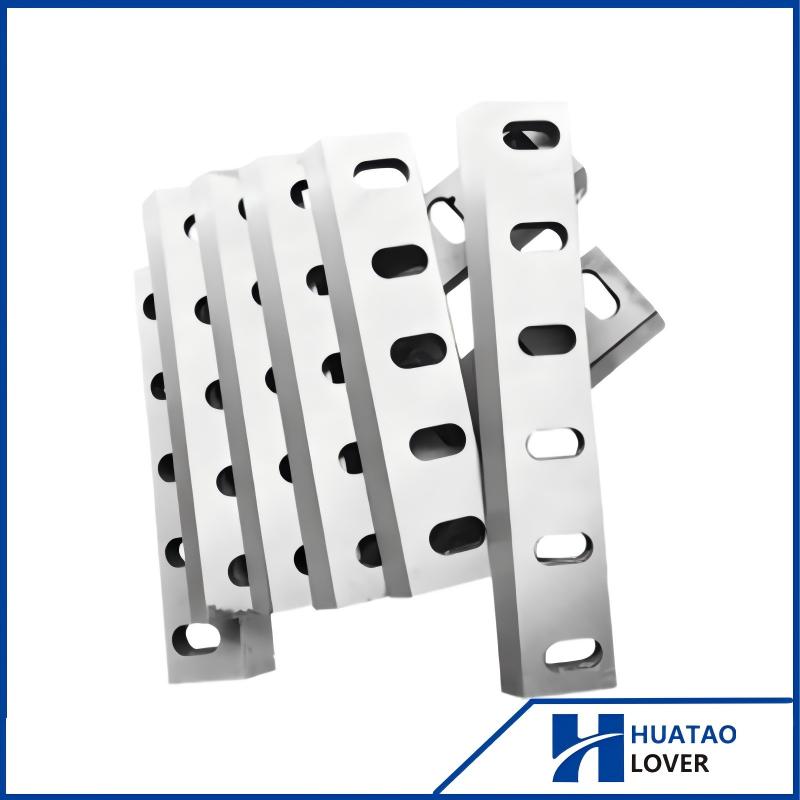
Where in-house sharpening is required, review the Fully Automatic Linear Knife Sharpener and HT800mm Automatic Sharpener.
For more information on maintenance workflow, see Blade Sharpening Challenges in Plastic Recycling and Industrial Blade Sharpener Design.
9. Procurement Checklist for Industrial Buyers
Before confirming an order, prepare the following:
-
Machine model and manufacturer
-
Blade drawing or physical sample
-
Blade dimensions and tolerances
-
Hole positions and mounting details
-
Material grade and hardness requirements
-
Feedstock type and contamination level
-
Current blade service life
-
Failure photographs
-
Sharpening frequency
-
Required quantity and delivery schedule
Ask the supplier whether blades can be manufactured according to drawings, whether material documentation is available, and whether OEM replacement requirements can be supported.
10. Frequently Asked Questions
Is the highest-hardness blade always the best?
No. Hardness must be balanced with toughness, wear resistance and the actual operating load.
Can one blade material process every plastic type?
No single material should be assumed suitable for every plastic stream. Feedstock composition, fillers, contamination and machine design all matter.
Should buyers compare blade prices only?
No. Compare service life, sharpening frequency, downtime, replacement cost and processing output. Cost per ton is more meaningful than purchase price alone.
How can a supplier recommend the correct blade?
Provide the machine model, blade drawing, feedstock details, operating conditions and current blade failure information.
Conclusion
SKD11, D2, DC53 and LD are material options that should be assessed against the actual application. The best specification is the one that provides an appropriate balance of wear resistance, toughness, cutting performance and maintenance requirements.
A technically sound blade selection process begins with feedstock analysis and ends with performance monitoring under real operating conditions.
Contact HUATAO GROUP
Email: Team5@huataogroup.com
Tel / WeChat / WhatsApp: 008613383116640
WhatsApp: http://wa.me/13383116640
Website: www.huataoshredder.com
#PlasticCrusherBlade #BladeMaterial #SKD11 #D2 #DC53 #LDSteel #PlasticGranulator #BladeWear #IndustrialKnife #PlasticRecycling #OEMBlades #RecyclingMachinery



 WhatsApp