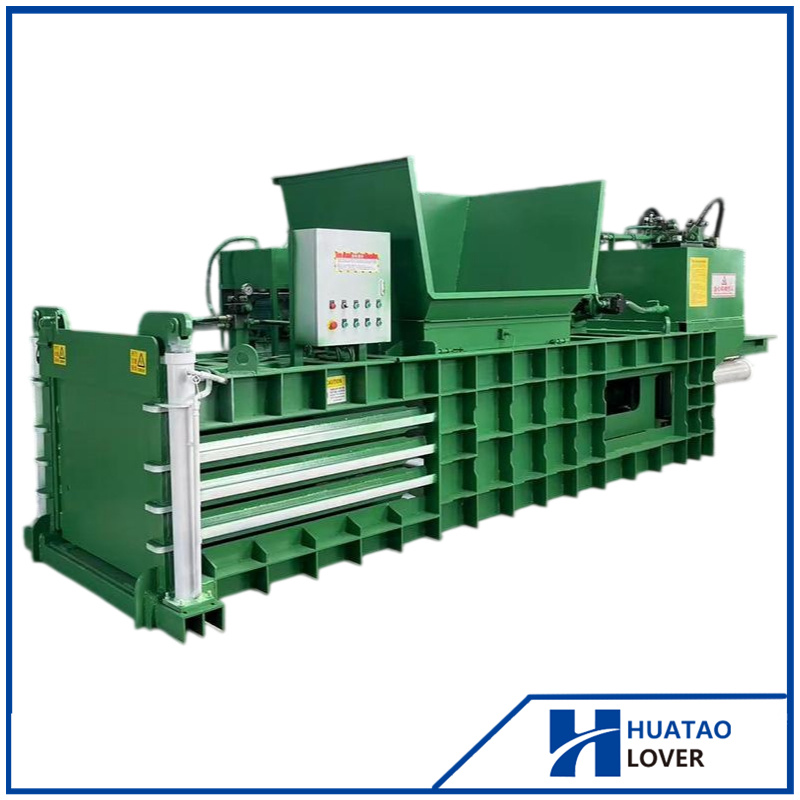
In recycling, attention goes to shredders, separators, and granulators. These are the machines that process material and recover value. They are the machines that appear in specification meetings, site visits, and trade show displays. But there is one piece of equipment that decides whether that recovered material can actually reach the market profitably — and it rarely receives the attention it deserves. That machine is the Hydraulic Baling Machine.
The Density Problem Nobody Talks About:
Recyclable materials share a characteristic that makes them expensive to handle: they are extraordinarily low in bulk density. Loose cardboard sits at 30–60 kg/m³. Loose PET bottles can be as low as 20 kg/m³. Loose aluminium cans reach only 60–100 kg/m³.
A standard trailer has roughly 76 m³ of volume and around 24 tonnes of payload. Filled with loose cardboard at 45 kg/m³, it carries about 3.4 tonnes — under 15% of capacity. The operator pays for a full truck and moves a fraction of a load. Every kilometre is wasted fuel, wasted driver time, wasted capital.
The Hydraulic Baling Machine corrects this imbalance. Baled cardboard reaches 180–250 kg/m³. Baled PET 200–300 kg/m³. Baled aluminium cans approach 300–400 kg/m³. The same trailer now carries 15–20 tonnes. Transport cost per tonne falls by 70–80%.
Huatao manufactures the Hydraulic Baling Machine in both horizontal and vertical configurations. Full specifications are on the Hydraulic Baling Machine product page, with additional options described on the Vertical And Horizontal Hydraulic Baler page.
Bale Quality Determines the Price You Receive:
Density alone does not secure a sale. Paper mills and plastic processors buy against specifications covering bale dimensions, weight range, moisture content, and prohibitive materials. Bales outside specification are rejected or discounted.
A Hydraulic Baling Machine that produces consistent, well-formed bales lets the operator meet specification reliably — and reliability commands a premium. Bale integrity during handling matters equally. A bale that bursts during loading or transport creates material loss and safety hazards. The binding system must match the material: high-tensile quenched steel wire for dense cardboard and metal, plastic strapping for lower-density streams.
Material-Specific Requirements:
Cardboard and paper. The highest-volume application in most markets. OCC compresses readily but springs back if inadequately secured. Densities of 180–250 kg/m³ are standard. Within a complete Waste Recycling Production Line, baling converts sorted paper into a transportable commodity.
Plastics. PET, HDPE, and film retain elastic memory and expand after compression unless restrained. A Hydraulic Baling Machine for plastic needs higher press force relative to thickness and a binding system that contains expansion.
Metals. Ferrous and non-ferrous scrap demands the highest press forces — 100 to over 600 tonnes. Integrated cutting blades on the press head shear long or stringy material. Vehicle scrap reaches 1.2–1.5 t/m³. In metal recovery, the baler typically follows primary shredding and separation — see the Scrap Metal Recycling Production Line for the process sequence. A Metal Briquetting Press offers an alternative for finer metal streams where briquetting suits downstream smelting better than baling.
Textiles. Used clothing compresses readily but needs consistent bale formation for export markets. The Waste Clothing Recycling Production Line shows where baling fits in that material stream.
Vertical or Horizontal: Matching the Machine to the Operation:
A vertical Hydraulic Baling Machine suits smaller operations with limited floor space and moderate volumes — retail premises, workshops, small manufacturing units. These units are typically manually fed and produce bales of 40–500 kg. For injection moulding plants and small packaging factories generating 200–1,000 kg of plastic waste daily, a vertical baler occupies only 2–3 square metres and achieves volume reduction ratios up to 88%. One operator can handle loading, compression, and ejection. The investment threshold is low. For a detailed selection walkthrough, see Focus On Small Medium Factories Vertical Hydraulic Baler.
A horizontal Hydraulic Baling Machine serves higher-volume operations — distribution centres, material recovery facilities, and processing plants. Semi-automatic or fully automatic configurations include conveyor feeding, automatic tying, and continuous operation. Throughput ranges from 1 to over 13 tonnes per hour, with bale weights from 200 kg to over 1,300 kg.
The Hidden Operational Benefits:
Beyond transport savings, baling delivers three operational advantages.
Floor space recovery. Loose recyclables consume vast warehouse or yard areas. Bales stack efficiently, reclaiming space with a calculable rental value.
Fire risk reduction. Loose stockpiles of cardboard, paper, and plastic present a serious fire hazard. Dense bales lack the surface area and airflow that allow rapid combustion — a factor many insurers recognise in risk assessments.
Labour efficiency. Loose material requires repeated handling. Baled material is moved as discrete units by forklift or pallet truck.
Calculating the Return on Investment:
The Hydraulic Baling Machine is unusual among industrial equipment because its ROI can be calculated with precision. The arithmetic is straightforward: transport cost per tonne before baling, transport cost per tonne after baling, and the difference multiplied by annual tonnage. Add the price premium from consistent bale specification. Add the value of reclaimed floor space.
For many operations, payback falls within twelve to twenty-four months. There is also a compliance dimension. Extended producer responsibility schemes and recycled content mandates increasingly require documented recovery and traceable material flows. Baled, weighed, and labelled material supports that documentation in a way loose waste cannot.
Maintenance: Protecting the Investment
The Hydraulic Baling Machine is a high-cycle machine. Hundreds of compression cycles per shift subject the hydraulic system, chamber walls, and tying mechanisms to continuous stress. Daily checks cover hydraulic fluid level, leak inspection, chamber inspection, and tying system verification. Weekly and monthly tasks include fluid condition checks, filter replacement, ram alignment inspection, and lubrication. Longer term, wear liners and hydraulic seals require replacement. Detailed guidance is available in How To Maintain A Hydraulic Baler.
Baling Within Complete Recycling Systems
The Hydraulic Baling Machine is rarely a standalone purchase. It sits at the end of a processing sequence that begins with size reduction and separation. In metal recovery, the Scrap Metal Recycling Production Line positions baling after shredding and eddy current separation. For tyre processors, the Waste Tire Crushing And Grinding Production Line shows how baling of recovered steel and rubber crumb fits into the output stage. E-waste operations follow a similar pattern — see the E Waste Recycling Line for the full configuration. For plastic bottle streams, the PET Bottle Recycling Line balances baling of inbound material with flake output.
The Point:
The Hydraulic Baling Machine does not merely process waste. It converts a cost centre into a revenue stream. If your operation generates recyclable material at scale, this is the machine that determines whether that material reaches the market economically.
Contact Us
Marketing@huataogroup.com
Tel:+86 13383116640 (WeChat/WhatsApp)
http://wa.me/13383116640
Website: www.huataoshredder.com
#HydraulicBalingMachine #BalingMachine #RecyclingEconomics #BaleDensity #CardboardBaler #Huatao #CircularEconomy #WasteToValue #WasteManagement #RecyclingEquipment



 WhatsApp