

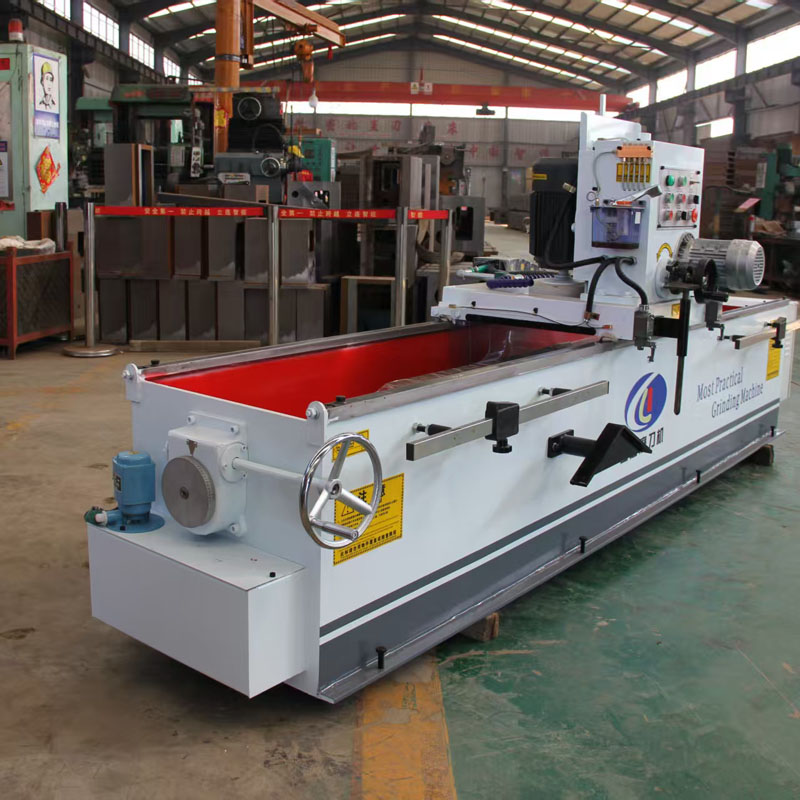
In high-volume recycling and manufacturing environments, the consistent sharpness of industrial blades is a non-negotiable requirement for maintaining throughput and product quality. A Knife Grinding Machine equipped with advanced features—such as PLC controls, CNC automation, and high-precision electromagnetic chucks—has become an indispensable tool for operations that rely on granulators, shredders, and other cutting equipment . The modern Knife Grinding Machine represents a significant technological advancement over manual sharpening methods, delivering repeatable accuracy, reduced labor costs, and extended blade life.
Advanced Control Systems: PLC and CNC Integration
The evolution of the Knife Grinding Machine is characterized by the integration of sophisticated control systems. A PLC (Programmable Logic Controller) is a standard feature on modern machines, managing the grinding wheel downfeed and carriage movement to ensure precise, repeatable, and automated sharpening operations -4-8. More advanced models offer full CNC (Computer Numerical Control) functionality, enabling the machine to store and recall sharpening programs for different blade types and automatically adjust grinding parameters .
These advanced control systems translate into several operational benefits:
1 Programmable Sharpening Cycles: The Knife Grinding Machine can be programmed for a specific number of passes and grinding depth, ensuring consistency across multiple blade sets.
2 Real-Time Diagnostics: Integrated control systems often provide immediate feedback on machine performance, enabling quick troubleshooting and maximizing uptime.
3 Reduced Operator Dependency: The automation capabilities of a modern Knife Grinding Machine minimize the reliance on skilled operators, reducing labor costs and the potential for human error.
Precision Grinding Mechanisms
The heart of any Knife Grinding Machine is its grinding head and table movement system. High-end models incorporate features that ensure exceptional accuracy:
1 Rack and Pinion Frequency Conversion Speed Regulation: The left and right travel of the grinding head on the Knife Grinding Machine is often controlled by a rack and pinion system with frequency conversion speed regulation. This allows the operator to precisely control the carriage movement speed, which is critical for achieving a consistent surface finish and preventing blade overheating .
2 Automatic Downfeed System: The grinding head on a CNC or semi-automatic Knife Grinding Machine can be set to automatically feed down by a specific amount after each pass, allowing the operator to set the total feed amount . This precise control over material removal ensures uniform sharpening and extends blade life.
3 Adjustable Stroke Control: The bed of the Knife Grinding Machine is typically equipped with travel switches or adjustable mechanical stops to control the stroke length of the grinding head . This feature is essential for machines with longer grinding capacities, as it prevents the grinding wheel from over-traveling and protects the machine's components.
Blade Material Compatibility:
A versatile Knife Grinding Machine is capable of sharpening blades made from a variety of materials. The machine's grinding wheel and settings can be adjusted to handle:
1 High-Speed Steel (HSS): Commonly used for paper knives, shear blades, and woodworking tools .
2 Carbide-Tipped Blades: Used in high-demand applications such as industrial knife manufacturing and specialized woodworking
3 Tool Steels (e.g., D2, DC53): Frequently used for granulator and shredder blades in recycling applications
Safety and Ergonomic Features:
1 Modern Knife Grinding Machine designs incorporate a range of safety and ergonomic features:
2 Splash Guards and Dust Covers: Many machines come with stainless steel splash guards and dust covers to protect the operator and maintain a clean working environment .
3 Sturdy Base Construction: The heavy-duty reinforced machine base provides excellent stability during grinding operations, reducing vibration and enhancing safety .
4 User-Friendly Controls: Machines with intuitive touchscreen interfaces and well-organized control panels make the Knife Grinding Machine accessible to operators with varying levels of experience
Economic and Operational Benefits:
1 The deployment of a high-performance Knife Grinding Machine yields measurable economic benefits:
2 Reduced Tooling Costs: Re-sharpening a blade set costs a fraction of the price of a new set, making the Knife Grinding Machine a cost-effective solution for tooling management.
3 Increased Equipment Uptime: The ability to maintain sharp blades reduces the risk of machine jams, overloads, and unscheduled downtime.
4 Improved Product Quality: A properly sharpened blade produces cleaner cuts, which is critical for product quality and reducing waste in manufacturing processes .
Contact us:
Marketing@huataogroup.com
Tel:+86 13383116640 (Wechat/whatsapp)
http://wa.me/13383116640
Website:www.huataoshredder.com
#KnifeGrindingMachine #CNCKnifeGrinder #BladeSharpening #RecyclingTechnology #IndustrialAutomation #PrecisionGrinding #Huatao #Tooling #Manufacturing #PLCControl
can not be empty
can not be empty

HUATAO GROUP - Recycling Machine and Spare parts
ADD : No.298 Zhonghua North Street, Shijiazhuang 050000 China.
TEL : +86 13383116640
EMAIL :marketing@huataogroup.com
 WhatsApp & WeChat : +86 13383116640