

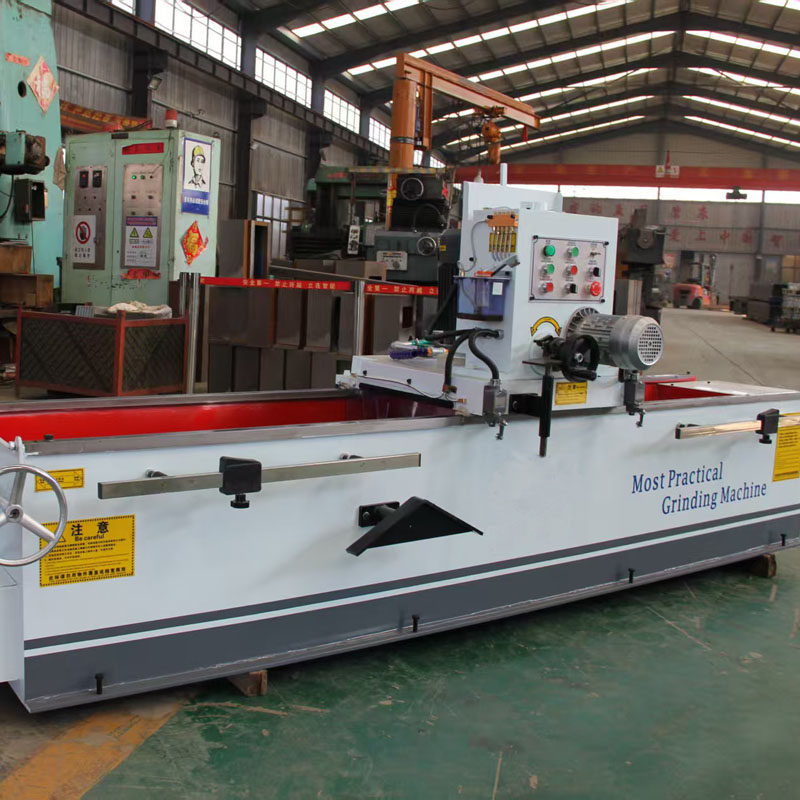
In the competitive landscape of recycling and manufacturing, operational costs are under constant scrutiny. Among the most significant—and often overlooked—expenses is the management of industrial cutting blades. A Knife Grinding Machine represents not merely a maintenance tool but a strategic investment that delivers measurable returns through extended blade life, reduced downtime, and lower energy consumption.
The Hidden Cost of Dull Blades:
Dull blades are a silent drain on productivity. When crusher, granulator, or shredder blades lose their edge, several negative consequences cascade through the operation. According to industry analysis, plastic crusher blades require regular sharpening—some as frequently as daily in high-volume operations—to maintain optimal performance .
The impact of dull blades includes:
1 Increased Energy Consumption: Dull blades force motors to work harder, consuming significantly more power per ton of material processed. Studies suggest that a sharp blade can reduce energy consumption by an estimated 15-20% compared to a dull counterpart.
2 Reduced Throughput: When blades fail to cut cleanly, material processing slows, reducing overall production capacity and affecting delivery schedules.
3 Poor Product Quality: Dull blades produce inconsistent particle sizes, jagged edges, and excessive fines—all of which reduce the value of recycled material.
4. Increased Machine Wear: Vibration from unbalanced or dull blades accelerates wear on bearings, seals, and drive components, leading to more frequent and costly repairs.
A Knife Grinding Machine directly addresses these issues by restoring blades to factory-specified geometry, ensuring clean cuts, balanced rotor performance, and optimal energy efficiency.
The Cost-Benefit Analysis of In-House Sharpening:
The decision to invest in a Knife Grinding Machine is ultimately an economic one. Industrial crusher blades typically cost between $100 and $1,000 or more each, depending on size and material -9. With a Knife Grinding Machine capable of extending blade life by 5 to 10 times through precise, minimal-material-removal sharpening, the return on investment is compelling .
Cost Comparison: In-House vs. Outsourcing
Factor: In-House Knife Grinding Machine vs. Outsourced Sharpening
Sharpening Cost per Blade: Minimal (abrasive wheel wear, coolant)$20–$50+ per blade
Lead Time: Minutes to hours; Days to weeks
Downtime Impact: Minimal (sharpened between runs);
Significant (machine idle)
Consistency Control: Full control; Variable
Logistics Costs: None; Shipping and handling
Beyond direct cost savings, the Knife Grinding Machine enables a proactive maintenance strategy. Rather than waiting for blades to become dangerously dull—risking machine damage and quality issues—operators can schedule sharpening at optimal intervals, maintaining peak performance continuously .
Preventing Heat Damage and Preserving Blade Investment
One of the most critical functions of a professional Knife Grinding Machine is the prevention of thermal damage during sharpening. Overheating during grinding can ruin the temper of tool steel, causing softening (loss of hardness) or micro-cracks that lead to premature blade failure.
High-end Knife Grinding Machine units incorporate coolant systems that continuously cool the grinding point, protecting the blade's metallurgical integrity .
For carbide-tipped blades—common in high-demand applications—a Knife Grinding Machine equipped with diamond grinding wheels is essential, as conventional abrasive wheels cannot effectively cut the extremely hard carbide material .
ROI Calculation: The Knife Grinding Machine Payback Period
A typical industrial Knife Grinding Machine represents a capital investment ranging from $3,000 to $20,000, depending on capacity and features . For a recycling operation processing 10 tons of plastic per hour with a blade set costing $2,000 that requires sharpening every 200 operating hours, the payback period can be remarkably short:
Annual blade replacement cost without sharpening: $10,000–$20,000+
Annual sharpening cost with in-house Knife Grinding Machine: $1,000–$2,000 (abrasive wheels, coolant, electricity)
Annual savings: $8,000–$18,000+
Estimated payback period: 3–6 months
Key Features That Maximize ROI
To realize the full economic benefits, a Knife Grinding Machine should incorporate:
Precision Electromagnetic Chuck: Securely holds blades flat, preventing warp and ensuring uniform sharpening.
Adjustable Angle Fixture: Enables exact replication of the original bevel angle, critical for maintaining cutting performance.
Automated Feed Systems: Eliminates human error, ensuring consistent results across multiple blade sets.
Coolant System: Prevents thermal damage and removes grinding debris.
Conclusion:
In today's margin-sensitive industrial environment, a Knife Grinding Machine is not a luxury but a necessity. By extending blade life, reducing downtime, lowering energy costs, and improving product quality, this equipment delivers a rapid and substantial return on investment. For any operation relying on cutting, granulating, or shredding equipment, the economic case for a Knife Grinding Machine is clear and compelling.
Contact us:
Marketing@huataogroup.com
Tel:+86 13383116640 (Wechat/whatsapp)
http://wa.me/13383116640
Website:www.huataoshredder.com
#KnifeGrindingMachine #ROI #BladeSharpening #CostSavings #Recycling #Manufacturing #IndustrialEfficiency #Huatao #ToolingManagement #Productivity
can not be empty
can not be empty

HUATAO GROUP - Recycling Machine and Spare parts
ADD : No.298 Zhonghua North Street, Shijiazhuang 050000 China.
TEL : +86 13383116640
EMAIL :marketing@huataogroup.com
 WhatsApp & WeChat : +86 13383116640