

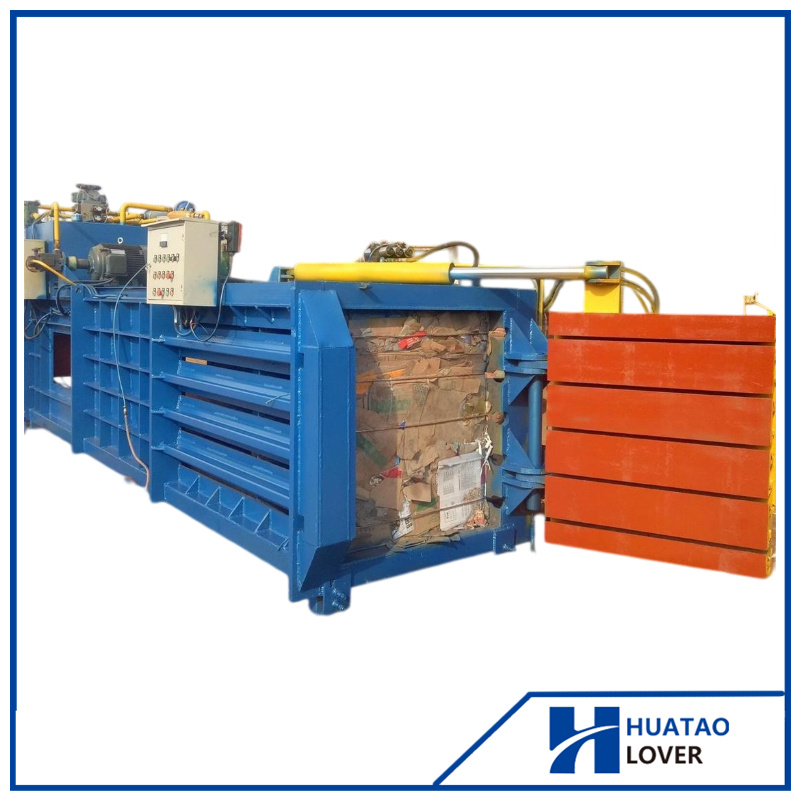
There is a moment in every recycling operation when the material stops being waste and becomes a commodity. That moment is not determined by the material itself. Cardboard is cardboard. Plastic is plastic. Metal is metal. What changes is the form in which the material is presented to the market — and that form is determined by the Hydraulic Baling Machine. A loose pile of corrugated board is a disposal problem. The same material compressed into a dense, strapped bale is a traded commodity with a published price, a specification, and a buyer. The Hydraulic Baling Machine is the machine that makes that transformation possible.
The Physics of Value: Why Density Determines Revenue
The economics of recyclable materials are governed by an inconvenient physical reality: most recyclable materials are extremely low in bulk density. Loose cardboard occupies between 30 and 60 kilograms per cubic meter. Loose PET bottles occupy as little as 20 kilograms per cubic meter. Loose aluminium cans, despite being metal, occupy only 60 to 100 kilograms per cubic meter in their uncompacted state.
The consequences of this low density are felt across the entire logistics chain. A standard 40-foot trailer has a volume of approximately 76 cubic meters and a payload capacity of roughly 24 tonnes. Filled with loose cardboard at 45 kilograms per cubic meter, that trailer carries just 3.4 tonnes of material — less than 15% of its payload capacity. The operator pays for a full truck and transports a fraction of a load. Every kilometre driven is a kilometre of wasted fuel, wasted driver time, and wasted capital.
The Hydraulic Baling Machine resolves this imbalance. By compressing loose material into dense bales, the machine raises bulk density to the point where the trailer's payload capacity becomes the limiting factor rather than its volume. Cardboard baled on a Hydraulic Baling Machine typically achieves 180 to 250 kilograms per cubic meter — a four- to five-fold increase over loose material. PET bottles baled on a Hydraulic Baling Machine reach 200 to 300 kilograms per cubic meter. Aluminium cans, when baled, approach 300 to 400 kilograms per cubic meter.
The arithmetic that follows is straightforward. A trailer loaded with bales produced by a Hydraulic Baling Machine can carry 15 to 20 tonnes of material instead of 3 to 4 tonnes. The transport cost per tonne falls by 70 to 80%. For an operation moving 500 tonnes of recyclable material per month, the annual transport saving alone can exceed the purchase price of the Hydraulic Baling Machine several times over.
Bale Quality and Commodity Pricing
Density is not the only variable that determines value. Bale quality — the consistency of dimensions, weight, and binding — directly affects the price a Hydraulic Baling Machine user can command in the market.
Paper mills and plastic processors purchase baled material against specifications. A mill buying OCC (old corrugated containers) may specify bale dimensions, weight range, maximum moisture content, and prohibitive material limits. Bales that fall outside specification are either rejected or accepted at a discount. A Hydraulic Baling Machine capable of producing consistent, well-formed bales allows the operator to meet specification reliably — and reliability is worth money.
Bale integrity during handling is equally important. A bale that breaks open during loading, transport, or unloading creates material loss, safety hazards, and cleanup costs. The binding system on the Hydraulic Baling Machine — whether steel wire, plastic strapping, or cord — must be matched to the material and the bale density. High-tensile quenched steel wire, applied through automatic tying mechanisms, is the standard for high-density Hydraulic Baling Machine applications where bale integrity is critical.
The Hidden Benefits: Space, Safety, and Labour
The financial case for the Hydraulic Baling Machine extends beyond transport and commodity pricing.
Floor space recovery is immediate and measurable. Loose recyclable material consumes vast areas of warehouse or yard space. Bales produced by a Hydraulic Baling Machine stack efficiently, occupying a fraction of the volume. For operations paying rent or mortgage on their premises, the space reclaimed by baling has a calculable value.
Fire risk reduction is a significant safety benefit. Loose stockpiles of cardboard, paper, and plastic present a serious fire hazard. Dense bales produced by a Hydraulic Baling Machine are far less combustible — they lack the surface area and airflow that allow loose material to burn rapidly. Many insurance providers recognize this difference in their risk assessments.
Labour efficiency improves as material handling becomes more systematic. Loose material requires repeated handling — sweeping, shovelling, loading, and unloading. Baled material is handled as discrete units by forklift or pallet truck. The Hydraulic Baling Machine converts an unpredictable, labour-intensive waste stream into a standardized material flow.
Selecting the Right Hydraulic Baling Machine for the Application
The Hydraulic Baling Machine market offers configurations spanning a wide range of capacity, automation, and press force. The correct specification depends on the material, the volume, and the operational context.
A vertical Hydraulic Baling Machine suits smaller operations with limited space and moderate volumes — retail premises, small manufacturing units, and workshops. These machines are typically manually fed and produce bales in the 40 to 500 kilogram range.
A horizontal Hydraulic Baling Machine serves higher-volume operations — distribution centres, material recovery facilities, and processing plants. These machines may be semi-automatic or fully automatic, with conveyor feeding, automatic tying, and continuous operation. Throughput ranges from 1 to over 13 tonnes per hour, with bale weights from 200 kilograms to over 1,300 kilograms.
The decisive selection criteria are the material type, the daily or shift volume, the available floor space, and the specification requirements of the downstream buyer.
The Return on Investment
The Hydraulic Baling Machine is unusual among industrial equipment in that its return on investment can often be calculated with precision. The savings are not estimates — they are arithmetic. Transport cost per tonne before baling, transport cost per tonne after baling, and the difference multiplied by annual tonnage. Add the price premium from consistent bale specification. Add the value of reclaimed floor space. The resulting figure determines the payback period, which for many operations falls within twelve to twenty-four months.
The Hydraulic Baling Machine does not merely process waste. It converts a cost centre into a revenue stream, and it does so with a mechanical simplicity that has proven reliable across decades of industrial service.
Contact us:
Marketing@huataogroup.com
Tel:+86 13383116640 (Wechat/whatsapp)
http://wa.me/13383116640
Website:www.huataoshredder.com
#HydraulicBalingMachine #BalingMachine #RecyclingEconomics #BaleDensity #CardboardBaler #PlasticRecycling #MetalRecycling #Huatao #CircularEconomy #WasteToValue
can not be empty
can not be empty

HUATAO GROUP - Recycling Machine and Spare parts
ADD : No.298 Zhonghua North Street, Shijiazhuang 050000 China.
TEL : +86 13383116640
EMAIL :marketing@huataogroup.com
 WhatsApp & WeChat : +86 13383116640