

Corrugated cardboard and mixed paper represent one of the highest-volume waste streams in industrial and commercial operations. Managing this material efficiently is not merely an environmental obligation but a logistics and cost-control challenge. Loose cardboard occupies substantial floor space, commands low prices from recyclers, and incurs disproportionate transport costs due to its low bulk density. The Hydraulic Baling Machine addresses each of these problems directly by compressing loose paper waste into dense, uniform bales that reduce storage requirements by up to 90% and significantly improve loading efficiency for transport .
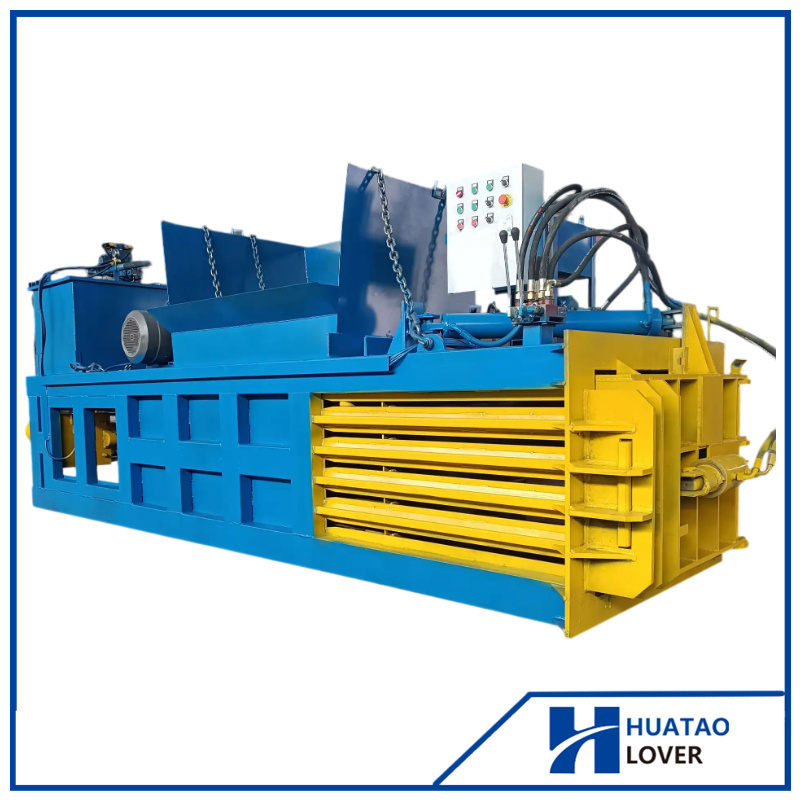
Understanding the Hydraulic Baling Machine Operating Principle
A Hydraulic Baling Machine operates through a hydraulic compression system that applies force to loose material within a confined chamber. The core components include the hydraulic cylinder, motor and oil tank, high-pressure pump, and control valve assembly -3. Material is introduced into the compression chamber—either manually, by conveyor, or through an automated feeding system—and the hydraulic ram advances to compress it against the chamber walls.
Once the material reaches a predetermined compression force or stroke position, the baling cycle pauses while the bale is secured with strapping wire or cord. The bale is then ejected, either through a door at the chamber end or by a pusher mechanism. This sequence repeats continuously, allowing the Hydraulic Baling Machine to process material at throughput rates ranging from 1 ton per hour in compact models to over 13 tons per hour in high-capacity configurations .
Horizontal vs. Vertical Configurations
The Hydraulic Baling Machine is available in two primary orientations, each suited to different operational scales and space constraints.
Horizontal balers are engineered for high-volume, continuous operation. These machines are typically specified for material recovery facilities (MRFs), paper mills, large distribution warehouses, and printing operations where daily cardboard volumes justify automation . Horizontal Hydraulic Baling Machine models offer press forces from 30 to 200 tons, with motor power ranging from 11 kW to 110 kW depending on throughput requirements -14. Bale weights for cardboard typically range from 40 kg in compact models to over 1,300 kg in high-capacity configurations .
Vertical balers are the appropriate choice for smaller operations with limited floor space. These Hydraulic Baling Machine units are compact, simpler to operate, and require lower initial investment. They are commonly deployed in retail locations, supermarkets, and small manufacturing facilities where cardboard waste is generated consistently but at lower volumes .
Key Selection Criteria for the Hydraulic Baling Machine
Specifying the correct Hydraulic Baling Machine requires assessment of several operational parameters.
Throughput Requirement. The volume of material the Hydraulic Baling Machine must process per hour determines the required chamber size, motor power, and press force. A facility generating 2 tons of cardboard per day has different requirements from one generating 20 tons per shift.
Bale Dimensions and Weight. Bale size affects downstream handling. Standard bale dimensions facilitate stacking, transport, and sale to paper mills. The Hydraulic Baling Machine can be configured with adjustable bale lengths, and some models offer customizable bale sizes to match specific logistics requirements .
Automation Level. Manual, semi-automatic, and fully automatic Hydraulic Baling Machine configurations are available. Fully automatic models incorporate PLC control with touchscreen interfaces, automatic feeding, and automatic tying systems, reducing labor requirements and enabling integration into automated sorting and conveying lines -15. German-engineered automatic tying technology is a feature of several high-end Hydraulic Baling Machine models, using high-tensile quenched steel wire for secure bale formation .
Operational Efficiency and Cost Recovery
The economic case for the Hydraulic Baling Machine is straightforward. Compressing cardboard into dense bales reduces transport costs by maximizing payload per truck, improves storage efficiency by reclaiming floor space, and produces a standardized commodity that commands better prices from paper mills and recyclers . Bales that are consistently formed and securely tied resist breakage during handling, reducing material loss and maintaining the value of the output.
Modern Hydraulic Baling Machine designs also incorporate energy-saving hydraulic systems with fast cycle times. Some models achieve empty cycle times of 15 seconds or less, contributing to higher overall throughput without proportional increases in energy consumption .
Contact us:
Marketing@huataogroup.com
Tel:+86 13383116640 (Wechat/whatsapp)
http://wa.me/13383116640
Website:www.huataoshredder.com
#HydraulicBalingMachine #CardboardBaler #PaperRecycling #OCC #WasteCompaction #RecyclingEquipment #Huatao #CircularEconomy #LogisticsEfficiency #Sustainability
can not be empty
can not be empty

HUATAO GROUP - Recycling Machine and Spare parts
ADD : No.298 Zhonghua North Street, Shijiazhuang 050000 China.
TEL : +86 13383116640
EMAIL :marketing@huataogroup.com
 WhatsApp & WeChat : +86 13383116640